[LCH]≡ PDF The Protestant Ethic and the Spirit of Capitalism
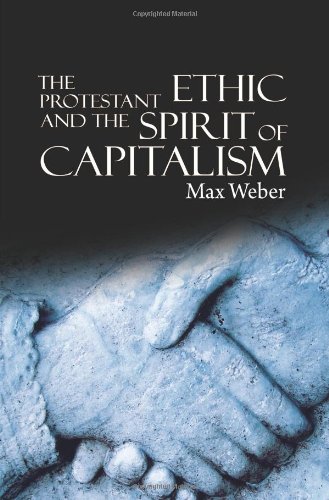
Tapa blanda – 9 septiembre 2008

You can download in the form of an ebook: pdf, kindle ebook, ms word here and more softfile type. The Protestant Ethic and the Spirit of Capitalism, this is a great books that I think.

Outdated The theories proposed in his time have been discredited today. Basically the elect for salvation were predetermined. Nothing could make one to save his soul. There was a chosen group. No one will be saved by works. So the protesters began to work and work to accumulate material wealth and luxurious living which was a sign that they were elected. It is the Protestant ethic. The origin of capitalism. Very fashionable for a long time to explain why the rich are rich. It has many other things but the main point is this. Appallingly proof-read & serious mistranslations
The Protestant Ethic and the Spirit of Capitalism 'Max Weber is the one undisputed canonical \ufb01gure in contemporary sociology.' The Times Higher Education Supplement 'Weber's essay is certainly one of the most fruitful examinations of the relations between religion and social theory which has appeared, and I desire to
Weber bluntly states Protestant beliefs were not solely or even mainly responsible for the rise of capitalism. Protestants helped capitalism evolve but that's it. In this regard many of those referencing Weber in a negative way are in error. While parts of Weber are tough sledding, he does provide several little anecdotes and factoids.
The Protestant Ethic and the Spirit of Capitalism (German: Die protestantische Ethik und der Geist des Kapitalismus) is a book written by Max Weber, a German sociologist, economist, and politician.
The Protestant Ethic and the Spirit of Capitalism Author's best-known and most controversial study relates the rise of a capitalist economy to the Puritan belief that hard work and good deeds were outward signs of faith and salvation. Maximilian Karl Emil Weber (21 April 1864 - 14 June 1920)
The Protestant Ethic and the Spirit of Capitalism Max Weber's The Protestant Ethic and the Spirit of Capitalism is a study of the relationship between the ethics of ascetic Protestantism and the emergence of the spirit of modern capitalism.
The Protestant Ethic and the Spirit of Capitalism is a book written by sociologist and economist Max Weber in 1904-1905. The original version was in German and it was translated into English by Talcott Parsons in 1930. In the book, Weber argues that Western capitalism developed as a result of the Protestant work ethic.
The Protestant Ethic and the Spirit of Capitalism Max Weber From Max Weber, The Protestant Ethic ami the Spirit of Callita/ism, trans. Talcott Parsons (New York: Charles Scribner & Sons, 1958 [1904-5)), pp. 47-56, 87-92, 180-3. Reprinted by permission of Simon & Schuster, Inc., New York. Abridged, references and most notes removed.
The Protestant Ethic and the Spirit of Capitalism was only a small part of Weber's published and unpublished work. In order to place the book in the context of Weber's wider outlook, Parsons ...
The Protestant Ethic and the Spirit of Capitalism The Protestant Ethic and the Spirit of Capitalism was written by Max Weber in 1904 and 1905.
In particular, Weber focuses on traditional Protestant ethics and the modern "spirit of capitalism." He defines these ethics by explaining how Protestants differed from Catholics. Amongst other differences, Protestants believed that working hard should be valued for its own sake.
Weber argued that the protestant ethic is closely associated with the spirit of capitalism. In order to bring out this inter-relationship, Weber constructed ideal types of both, the protestant ethics and the spirit of capitalism. However it is the inter-relationship and interdependence of "ideational" and "material" factors in history.
In 1904, Weber published the first version of The Protestant Ethic and the Spirit of Capitalism, which marked the beginning of his study of religion as a primary social force. Weber continued as an independent academic until World War I, where he volunteered to serve as a reserve officer, in charge of logistics for Germany's army hospitals.
Ideal for courses in sociology, anthropology, political science, history, international relations, economics, and cultural studies, The Protestant Ethic and the Spirit of Capitalism is an essential resource for anyone seeking to understand the origins and endurance of the modern West.
The Protestant Ethic and the Spirit of Capitalism. STUDY. Flashcards. Learn. Write. Spell. Test. PLAY. Match. Gravity. Created by. ecain21. Terms in this set (11) The Spirit of Capitalism. Only understandable meaning to which this term can be applied with is a historical individual. A complex of elements associated in historical a which we ...
The Protestant Ethic and the Spirit of Capitalism. The Protestant ethic \u2014 a moral code stressing hard work, rigorous self-discipline, and the organization of one's life in the service of God \u2014 was made famous by sociologist and political economist Max Weber. In this brilliant study (his best-known and most controversial), he opposes the ...
The concept spirit of capitalism is here used in this specific sense, it is the spirit of modern capitalism. For that we are here dealing only with Western European and American capitalism is obvious from the way in which the problem was stated. Capitalism existed in China, India, Babylon, in the classic world, and in the Middle Ages.
But not all the Protestant denominations seem to have had an equally strong influence in this direction. That of Calvinism, even in Germany, was among the strongest, it seems, and the reformed faith more than the others seems to have promoted the development of the spirit of capitalism, in the Wupperthal as well as elsewhere.
Overview In The Protestant Ethic, Max Weber opposes the Marxist concept of dialectical materialism and relates the rise of the capitalist economy to the Calvinist belief in the moral value of hard work and the fulfillment of one's worldly duties.
The Protestant Ethic and the Spirit of Capitalism Quotes Showing 1-30 of 64 "specialists without spirit, sensualists without heart; this nullity imagines that it has attained a level of civilization never before achieved." \u2015 Weber Max, The Protestant Ethic and the Spirit of Capitalism 85 likes
Ideal for courses in sociology, anthropology, political science, history, international relations, economics, and cultural studies, The Protestant Ethic and the Spirit of Capitalism is an essential resource for anyone seeking to understand the origins and endurance of the modern West. You May Also Like
In The Protestant Ethic, Max Weber opposes the Marxist concept of dialectical materialism and relates the rise of the capitalist economy to the Calvinist belief in the moral value of hard work and...
The Protestant Ethic and the Spirit of Capitalism (1905) [PESC], of course, is also a product of this early period. But to describe it merely so fails to capture how it occupied the rest of Weber's life's work. Weber's reputa tion as a key sociological thinker rests on his argument concerning the
Protestant Individualism and the Emergence of Capitalism Based on historical observation and analysis, Weber theorized this was because these were the only two countries in which Protestantism was the predominant religion, rather than Catholicism, which was the formal religion of every other European country.
views on Protestant ethic. German sociologist Max Weber, in The Protestant Ethic and the Spirit of Capitalism (1904-05), held that the Protestant ethic was an important factor in the economic success of Protestant groups in the early stages of European capitalism; because worldly success could be interpreted as a sign of eternal salvation, it\u2026.
The Protestant ethic and the spirit of capitalism. 1930, Scribner. in English. bbbb. Read Listen. Download for print-disabled. Libraries near you: WorldCat. 22. The Protestant ethic and the spirit of capitalism.
In part one of Max Weber's The Protestant Ethic and Spirit of Capitalism, he attempts to find a reason as to why Protestants have found themselves in far better economic situations, throughout history, as compared to Catholics. Weber examines differences in the two religions including education and the differing desire as to what line of work ...
The Protestant Ethic and the Spirit of Capitalism Summary. Max Weber states that in every country with multiple Christian denominations (at least in Europe and America) a certain "social stratification" occurs between Protestants and Catholics \u2014Protestants occupy the majority of the business leadership and skilled labor roles, while ...
Max Weber's best-known and most controversial work, The Protestant Ethic and the Spirit of Capitalism, first published in 1904, remains to this day a powerful and fascinating read. Weber's highly accessible style is just one of many reasons for his continuing popularity. The book contends that the Protestant ethic made possible and encouraged the development of capitalism in the West. Widely ...
Comments
Post a Comment